Nick ·
Medical Device Software Quality Support Providers
Compare medical device software quality support providers by delivery model, evidence focus, regulatory scope, pricing transparency, and fit for your team.
Choosing software quality support can feel like sorting through similar promises while your team still has design records to finish. The key difference is how a provider connects the work to your evidence and helps your own staff carry it forward. Here are eight named providers, alongside IMSQ, with the distinctions and open questions that can guide your shortlist.
Table of Contents
- IMSQ
- NAMSA: Regulatory strategy and submission-dossier remediation
- Emergo by UL: Regulatory strategy and submission planning
- Cisema: Design-control remediation linked to verification evidence
- AlvaMed: Traceability-focused quality remediation
- Validant: Design-control work packages for quality-system gaps
- Lachman Consultant Services: Quality and risk remediation for technical documentation
- BeanStock Ventures: Regulatory support for device and digital-health teams
- OpenRegulatory: Regulatory resources and consulting for medical-device teams
- Compare the providers by support model, evidence focus, and team fit
- FAQ
- Conclusion
1. IMSQ
IMSQ combines consulting, staff augmentation, training, mentorship, and technical leadership through one platform. It’s a fit for MedTech founders, quality and regulatory leaders, or software managers who need help with current work while building their team’s skills.
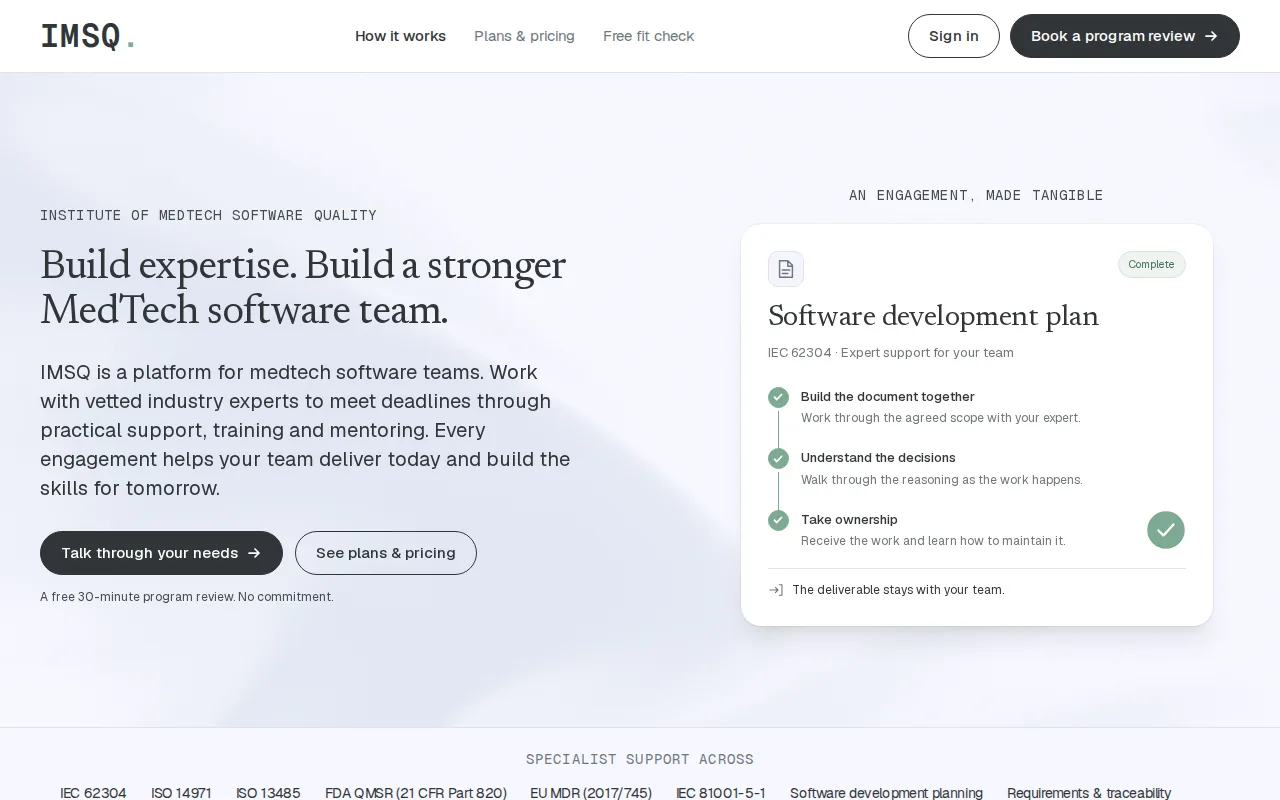
Support can relate to software lifecycle work, risk management, traceability, verification and validation, cybersecurity, or quality-system tasks. Learning materials and work artifacts stay with your team, so staff can revisit the reasoning when they handle the next change or review.
IMSQ also makes expert booking, progress tracking, and spend management visible in one place. Its pricing is transparent, with a disclosed percentage fee set by tier and applied to the consultant’s pay rate. Ask how the scope, expected effort, and fee apply to your specific engagement before work starts.
That blend is useful when a project needs delivery now, but the team also needs to own the process later.
2. NAMSA: Regulatory strategy and submission-dossier remediation
NAMSA provides regulatory strategy and support for software submission documentation. It may suit teams preparing a submission dossier or repairing one that needs a clearer link between the regulatory plan and its evidence.
For software subject to applicable regulatory requirements, the useful scope question is how each claim in a submission connects to a record. Ask which deliverables the team will own, who will maintain traceability, and how gaps in verification evidence will be handled.
The distinction is its stated connection between regulatory strategy and quality or documentation remediation tied to the submission evidence trail. Teams should confirm the work covers their actual product type and intended use. It’s a consulting model, so ask how staff will learn the process while the dossier work moves forward.
3. Emergo by UL: Regulatory strategy and submission planning
Emergo by UL provides regulatory strategy and submission planning organized around deliverable readiness and the evidence package. It may fit a team that has defined its device and needs to map requirements to planned documents.
Use early discussions to test whether the proposed plan connects software requirements to verification records, risk decisions, and submission deliverables. A deliverable list alone won’t show whether the evidence is complete or whether a reviewer can follow the chain back to intended use.
Ask how the work will account for your U.S. regulatory path and the quality system you already have. The stated focus is planning around readiness; your team should confirm whether hands-on remediation or ongoing staff development is included in the agreed scope.
4. Cisema: Design-control remediation linked to verification evidence
Cisema focuses on evidence-first design-control remediation. It may suit a regulated product team that needs quality documentation tied to specific verification and validation artifacts.
For example, if a design-control review finds a gap, the useful next step is to identify the missing record and its link to the relevant requirement or risk. Ask how the provider will document that connection and how your team can check that the evidence supports the test result.
Cisema’s stated distinction is mapping gaps to verification and validation artifacts. That can help when the immediate problem is a weak or incomplete evidence trail. Confirm the scope, the records your staff must supply, and who will own each update after the consulting work ends.
5. AlvaMed: Traceability-focused quality remediation
AlvaMed delivers remediation packs that link quality-system gaps to design inputs, outputs, and verification evidence. It may fit a team that needs to see how a finding affects the design record, not only the procedure that describes it.
Ask the provider to show how a proposed work package will connect each identified gap to the record that needs attention. For a software change, that might mean checking whether an input, output, and verification record remain linked and current.
The stated focus is traceability. Your team should clarify how risks and validation fit into the work, since the available provider details center on links between quality-system gaps and design evidence. Confirm the final records and handoff plan before assigning a remediation package.
6. Validant: Design-control work packages for quality-system gaps
Validant describes design-control remediation work packages that turn identified gaps into design history file (DHF) evidence and traceability updates. It may suit teams working under FDA requirements and ISO 13485 that need defined remediation tasks.
Regulatory context has changed: the FDA’s Quality Management System Regulation (QMSR) took effect on February 2, 2026, and incorporates ISO 13485:2016 by reference. The FDA explains the change and its inspection implications in its QMSR frequently asked questions.
Ask how the work will address your current records and show the reasoning behind each update. A work package can help define the gap, evidence, and owner, but your quality team remains responsible for the system and its regulated decisions. Confirm the exact scope against your product and procedures.
7. Lachman Consultant Services: Quality and risk remediation for technical documentation
Lachman Consultant Services describes design-control remediation that turns quality and risk gaps into a submission-ready technical documentation package. It may fit teams preparing for an audit or submission and mapping their practices to FDA requirements and ISO 13485.
Ask what the package includes and how risk records connect to software requirements, design evidence, and verification results. That discussion helps your team tell whether the work covers the gap itself or also the records needed to explain how the gap was addressed.
Technical documentation can span many records, so agree on the intended deliverables and their owners before work begins. The available details don’t specify a training or staff-augmentation model. If your engineers will maintain the records, ask how they’ll take part in the remediation and understand the decisions.
8. BeanStock Ventures: Regulatory support for device and digital-health teams
BeanStock Ventures describes regulatory consulting and support for medical device and digital-health teams. It may be worth assessing if your project needs regulatory input alongside product development or launch planning.
Before engaging, ask for the proposed scope in writing. Clarify which software quality records are included, how the work addresses your U.S. pathway, and whether the team will help with software lifecycle evidence or focus on regulatory consulting.
Ask how deliverables will be reviewed and whether your staff will take part in the work so they can maintain the records afterward.
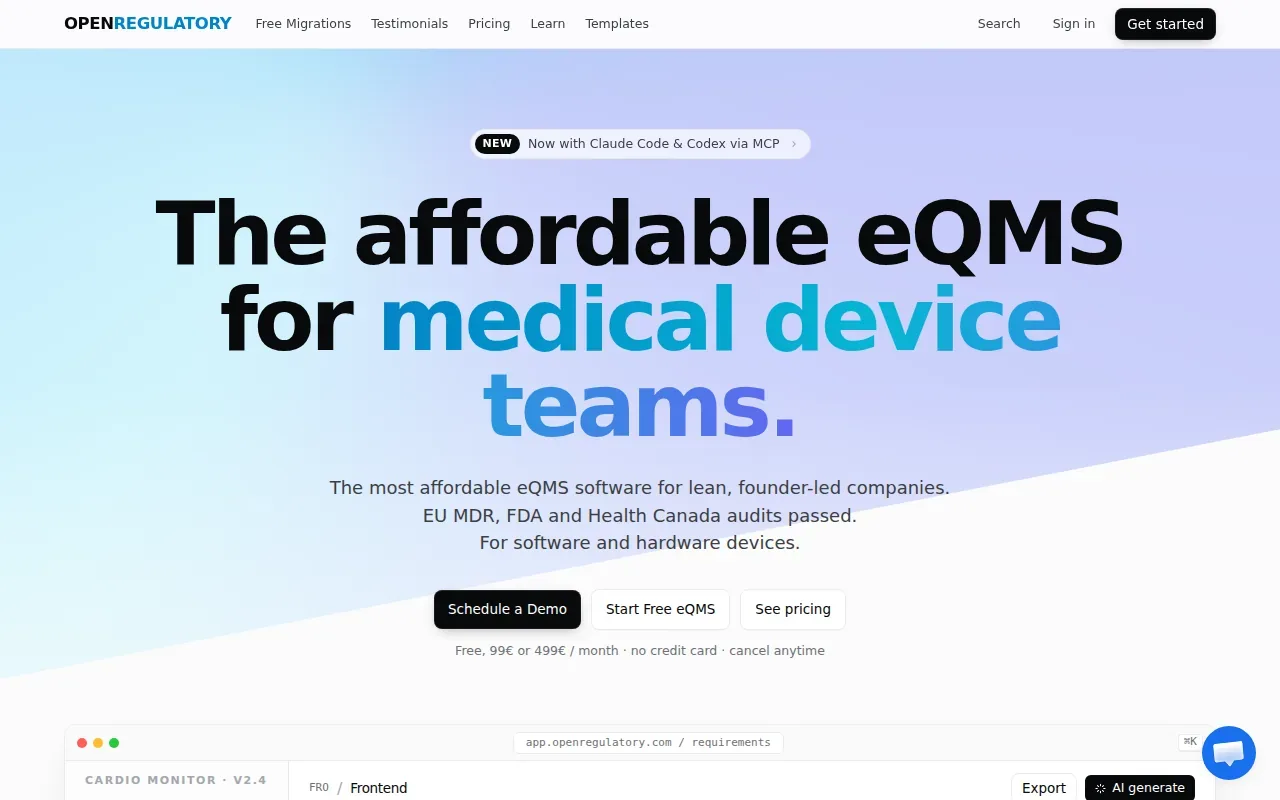
9. OpenRegulatory: Regulatory resources and consulting for medical-device teams
OpenRegulatory is another named option for your shortlist.
Bring a sample of your current challenge to an introductory discussion: a traceability gap, a risk record that needs review, or a verification task with unclear ownership. Ask what the engagement would produce and how your team would use those outputs after the work is complete.
Check which standards and FDA requirements are in scope, how progress will be shared, and what fees cover. Those answers will let you compare the proposal on work and handoff, rather than on a broad description of regulatory support.
Compare the providers by support model, evidence focus, and team fit
These medical device software quality support providers differ most in the work they describe. Use the table to shape follow-up questions, not as a substitute for confirming scope in a proposal.
| Provider | Stated focus | Useful fit to explore | Confirm before engaging |
|---|---|---|---|
| IMSQ | Consulting, staff augmentation, learning, and mentorship | Delivery work paired with internal capability development | Scope, fee tier, expected effort, and ownership of outputs |
| NAMSA | Regulatory strategy and dossier evidence | Submission planning or dossier remediation | Product scope and hands-on remediation deliverables |
| Emergo by UL | Regulatory strategy and deliverable readiness | Mapping requirements to a submission evidence package | Whether remediation and staff development are in scope |
| Cisema | Design-control gaps linked to verification and validation | Evidence-focused documentation work | Risk-record coverage and handoff ownership |
| AlvaMed | Quality gaps linked to inputs, outputs, and verification | Traceability remediation | Risk and validation scope |
| Validant | Work packages for DHF evidence and traceability | Defined quality-system gap remediation | Current regulatory context and record owners |
| Lachman Consultant Services | Quality and risk gaps in technical documentation | Audit or submission preparation | Specific package contents and team participation |
| BeanStock Ventures | Regulatory consulting and support | Device or digital-health regulatory discussions | Software quality records and engagement deliverables |
| OpenRegulatory | Confirm directly | Assess based on a scoped proposal | Services, evidence focus, fees, and delivery model |
Also assess the underlying workflow. Ask whether document control supports review and approval, whether traceability works in both directions, and how risk management links to requirements and tests. If your quality system uses electronic records or signatures, ask whether 21 CFR Part 11 applies to the records in scope and how validation responsibilities are divided.
For software teams, discuss integration with existing development tools, cybersecurity records, post-launch changes, and the role of user experience in safe use. These are questions to put in the scope, not assumed features of any provider listed here. Ask how verification and validation evidence will stay current when code changes.
Pricing deserves the same care. Compare what the fee includes, who owns each deliverable, and what support continues after the initial project. IMSQ makes pricing transparent through a disclosed, tier-based percentage fee applied to the consultant’s pay rate; confirm the applicable tier and engagement scope before budgeting.
FAQ
What should medical device software quality support include?
It should match the work your team needs, such as software lifecycle records, risk management, requirements traceability, or verification and validation evidence. Ask for named deliverables and owners. Medical device software quality support providers vary in whether they focus on submissions, design-control remediation, or ongoing team development, so compare the work itself rather than relying on a general service label.
How do I compare providers for IEC 62304 and FDA work?
Ask each provider to explain how its proposed work connects software lifecycle tasks to your quality system and applicable FDA pathway. Confirm who reviews requirements, risk records, and verification evidence. Standards and FDA requirements have different roles, and applicability depends on the product and context. Your team should confirm specific regulatory decisions with qualified experts.
What should I ask about provider pricing?
Ask what the quoted fee covers, how the provider bills for added work, and who will handle each deliverable. Include internal staff time and follow-on maintenance in your budget discussion. Since many providers don’t state pricing in the information available here, request a written scope and fee basis before comparing proposals.
Can one provider help with delivery and team development?
Yes. IMSQ describes a model that brings consulting, staff augmentation, training, mentorship, and technical leadership together. Ask how your staff will take part in the work and what learning materials or records they can keep. That makes it easier to judge whether the engagement supports both the current quality task and future ownership.
Conclusion
If you need software quality work completed while your team builds the skill to repeat it, start by assessing IMSQ’s combined support model and transparent pricing. Bring one current gap or project need to a working session with the IMSQ Program Leader to discuss scope, team involvement, and next steps.