Nick ·
ISO 13485 Training Options for MedTech Teams
Compare ISO 13485 training for MedTech teams by course type, duration, prerequisites and credentials, with practical guidance for software-quality work.
Choose ISO 13485 training around the work your team needs to perform. Requirements training helps people understand the standard. Internal auditor training develops audit skills within your organization. Lead auditor training prepares learners for broader audit responsibilities. Software teams may also need specialist support to apply that knowledge to development processes and product evidence.
This guide compares four options across audience, format, time commitment and learning outcomes. It includes three auditor courses and one broader software-quality support option; they serve different needs rather than forming a like-for-like ranking.
Provider information and regulatory sources checked October 27, 2026. Confirm the current syllabus, availability and terms before booking.
Contents
- Which type of ISO 13485 training do you need?
- Compare ISO 13485 training options for MedTech teams
- IMSQ: software-quality training and expert support
- Comply Guru ISO 13485 Lead Auditor: blended audit preparation
- Comply Guru ISO 13485 Internal Auditor: blended team training
- SGS ISO 13485:2016 Internal Auditor: audit planning and evidence review
- What to check before enrolling your team
- How to turn ISO 13485 training into useful work
- Frequently asked questions about ISO 13485 training
- Choose your team's next step
Which type of ISO 13485 training do you need?
ISO 13485:2016 sets quality management system requirements for organizations involved with medical devices. A quality management system, or QMS, describes how an organization controls its work and maintains the records needed to demonstrate that those controls operate.
A useful training brief starts with a role and a task. “Understand ISO 13485” is broad. “Plan an internal audit of our software change process” is specific enough to compare syllabuses and practice exercises.
- Awareness or requirements training: consider this for people who are new to the standard or need to understand how QMS requirements relate to their role. Look for clear explanations and examples before moving to audit techniques.
- Internal auditor training: consider this for staff who will plan, conduct, report on or follow up internal audits. Check what prior knowledge the course expects.
- Lead auditor training: consider this for people preparing to lead audits or take on broader supplier and external audit responsibilities. Confirm that the intended qualification route matches the course.
- Applied software-quality support: consider this when your team understands the concepts but needs help turning them into procedures, requirements, traceability or verification evidence.
One person may need more than one step. An engineer who is new to the QMS could begin with requirements training, practice using the company's procedures and then attend an internal auditor course. A QA leader preparing to lead audits may need a different route.
For a MedTech software team, the distinction matters: learning how to audit a process and learning how to design or operate that process are related skills, but each needs practice.
Compare ISO 13485 training options for MedTech teams
| Course facts reflect the sources linked in each provider section. SGS details refer to the cited brochure; local offerings may differ.Option | Primary fit | Format and time | Credential or output |
|---|---|---|---|
| IMSQ | Software-quality work alongside team development | Training and specialist engagements; scope and duration agreed for the need | Agreed work outputs and learning materials; no accredited auditor qualification claimed here |
| Comply Guru Lead Auditor | Learners preparing for full-system audit responsibilities | 40 hours; eLearning plus live workshops | CQI and IRCA certified course 2729; separate auditor-registration requirements apply |
| Comply Guru Internal Auditor | Team members preparing to audit their own QMS | 16 hours; eLearning plus live workshops | CQI and IRCA certified course 2765 |
| SGS Internal Auditor | Learners developing internal audit skills | Brochure: two days/16 hours; classroom or virtual instructor-led | Brochure: certificate of attendance; confirm local arrangements |
CQI is the Chartered Quality Institute; IRCA is the International Register of Certificated Auditors. A certified training course, an individual's professional auditor registration and an organization's ISO 13485 certification are different things.
Use the table to shortlist by role, then check prerequisites and assessment details below. Compare total learning time as well as live attendance: an online component still needs protected time in the employee's work schedule.
1. IMSQ: software-quality training and expert support
IMSQ — Institute of MedTech Software Quality combines training, consulting, staff augmentation, mentorship and technical leadership for MedTech software teams. It is relevant when your team needs help with current work while developing the ability to maintain and extend that work itself.
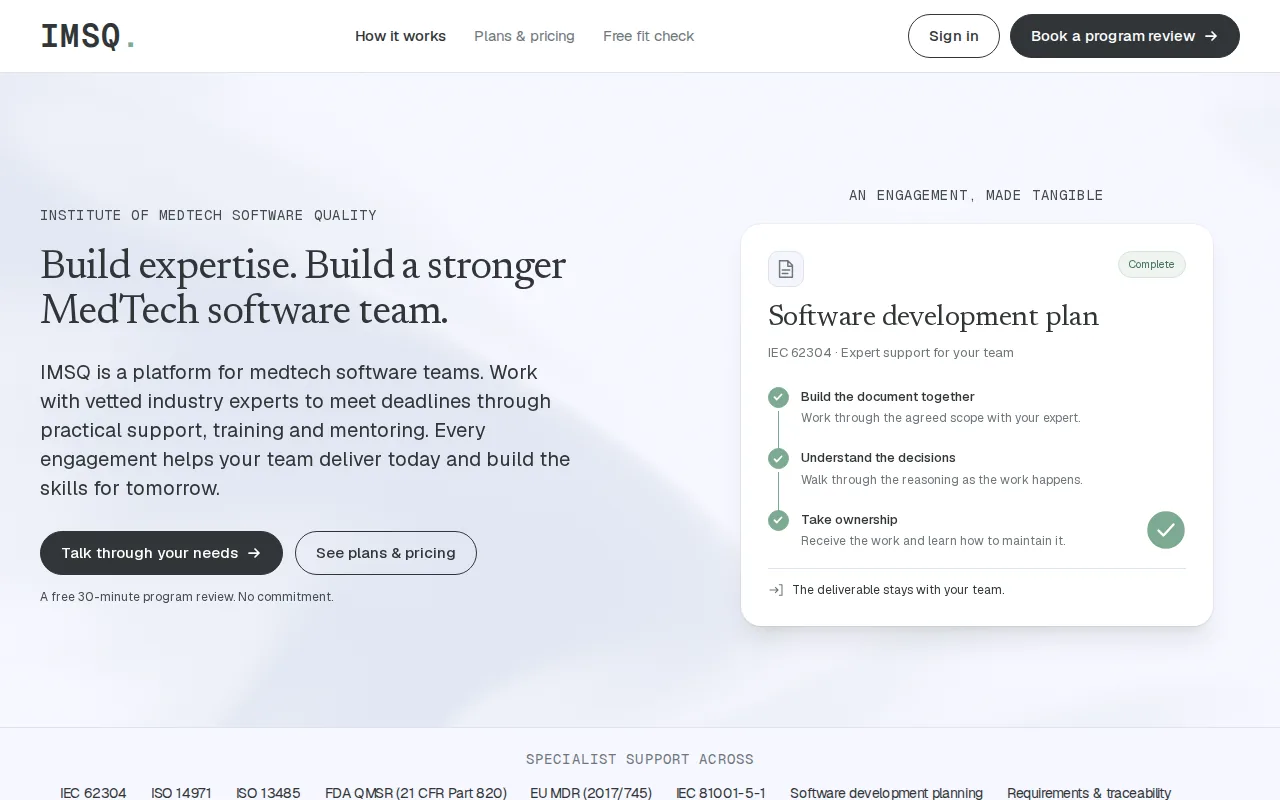
For example, a team might need to improve a software development plan, connect requirements to verification records or clarify how software changes move through review. The engagement can be scoped around that task, with an explanation of the reasoning and agreed materials the team can retain.
This is a different buying decision from selecting a fixed auditor course. Start by identifying the work output, the people who should learn from it and the internal owner who will maintain it. For related context, see IMSQ's discussion of SaMD risk management, where SaMD means software as a medical device.
Before booking: agree the scope, learning objectives, deliverables, duration and applicable commercial terms. If your goal is a formal auditor qualification, verify the required training route separately.
Consider this option when: your priority is applying software-quality knowledge to an active team challenge, with learning built into the work.
2. Comply Guru ISO 13485 Lead Auditor: blended audit preparation
Comply Guru's ISO 13485 Lead Auditor course is a 40-hour program combining eLearning with live instructor-led workshops. The provider lists it as CQI and IRCA certified course 2729 and describes preparation for full-system first-, second- and third-party audits.
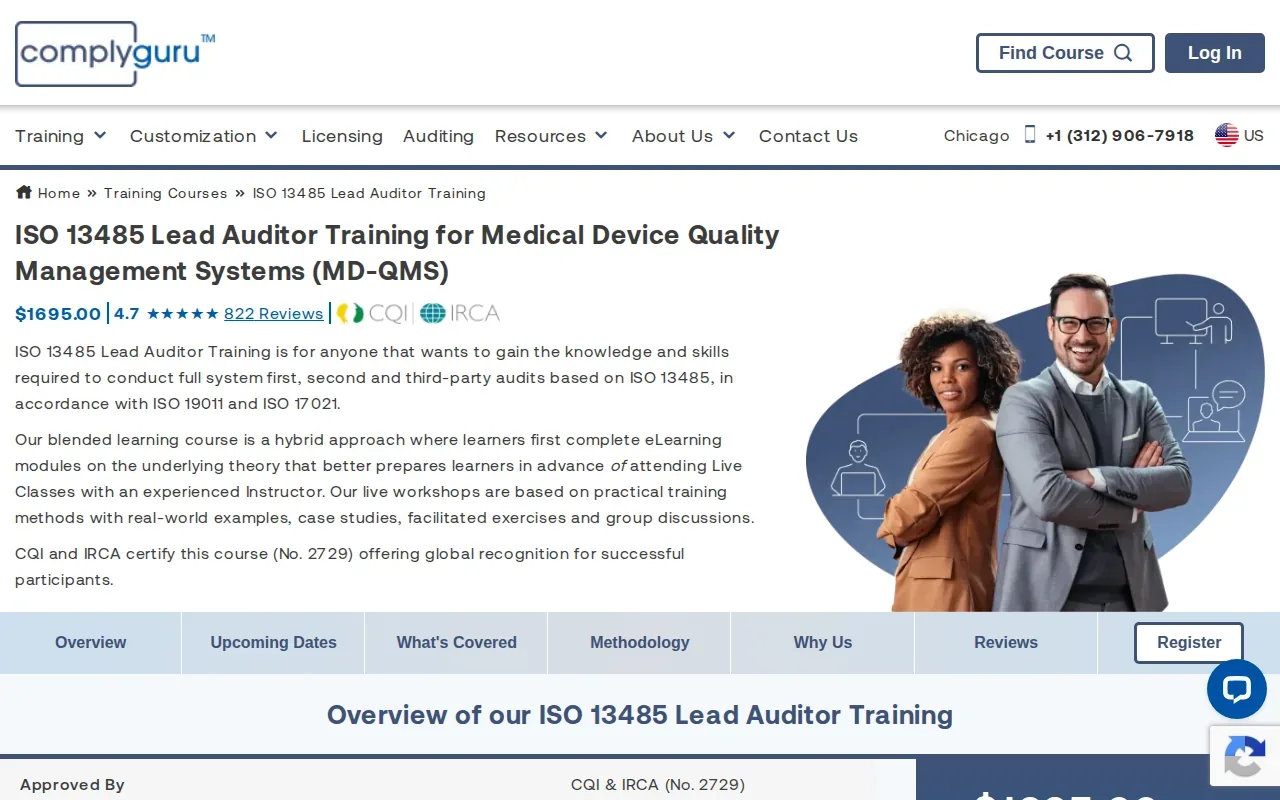
These audit categories cover an organization's own system, audits involving another party such as a supplier, and independent certification audits. The breadth makes this course worth considering for a quality professional moving into wider audit responsibilities.
Prerequisites and assessment: the provider requires prior ISO 13485 knowledge and recommends relevant quality-management or internal-audit experience. Successful completion includes assessments and a final examination. Confirm the learning schedule and assessment conditions for the cohort you choose.
Before reserving a place, define how the learner will gain supervised experience afterward. A course can develop audit knowledge and methods; it cannot provide familiarity with every device, supplier or software lifecycle the person may later assess.
Consider this option when: the learner needs structured lead auditor preparation and can commit to both independent study and live workshops. Completion alone does not grant professional lead auditor registration.
3. Comply Guru ISO 13485 Internal Auditor: blended team training
Comply Guru's ISO 13485 Internal Auditor course is a 16-hour program using eLearning and live workshops. It is listed as CQI and IRCA certified course 2765 and focuses on team members who will audit parts of a medical-device QMS.
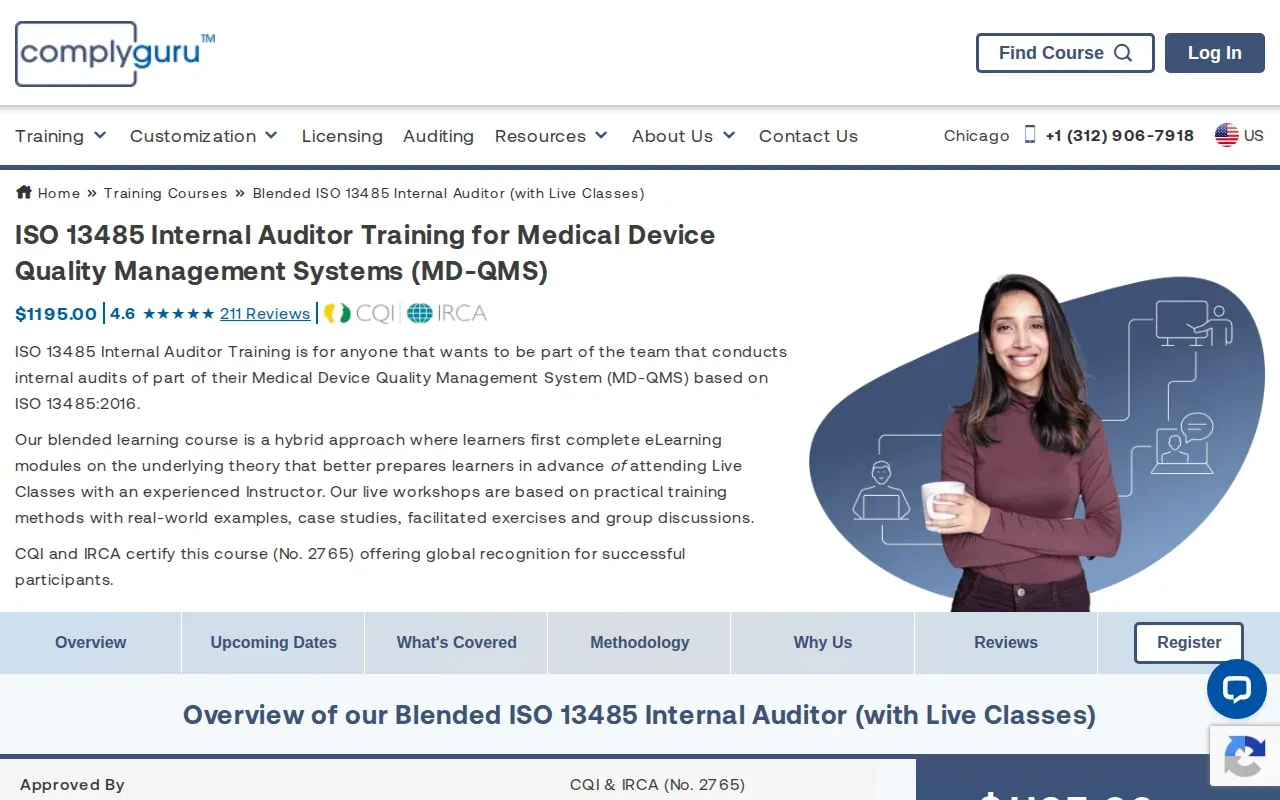
The provider recommends prior knowledge of ISO 13485 and familiarity with management-system concepts and relevant regulatory requirements. Workshops include audit preparation, simulated auditing, findings and reporting. Check the current assessment and certificate conditions before enrolling.
For a cross-functional team, the main benefit is a shared approach to asking questions, sampling records and writing findings. An engineer and a quality specialist may understand different parts of a software change process; audit training gives them a common method for examining evidence.
Before booking: identify the processes learners will audit and arrange access to the relevant procedures. Plan supervised practice with suitable independence from the work being reviewed.
Consider this option when: several employees need a structured internal audit method. Choose according to their assigned responsibilities and existing knowledge, rather than assuming the shorter course is automatically the right starting point.
4. SGS ISO 13485:2016 Internal Auditor: audit planning and evidence review
SGS offers internal auditor training covering audit planning, conduct, reporting and follow-up. Its official ISO 13485:2016 internal auditor brochure describes a two-day, 16-hour course available through face-to-face or virtual instructor-led delivery, with a certificate of attendance.
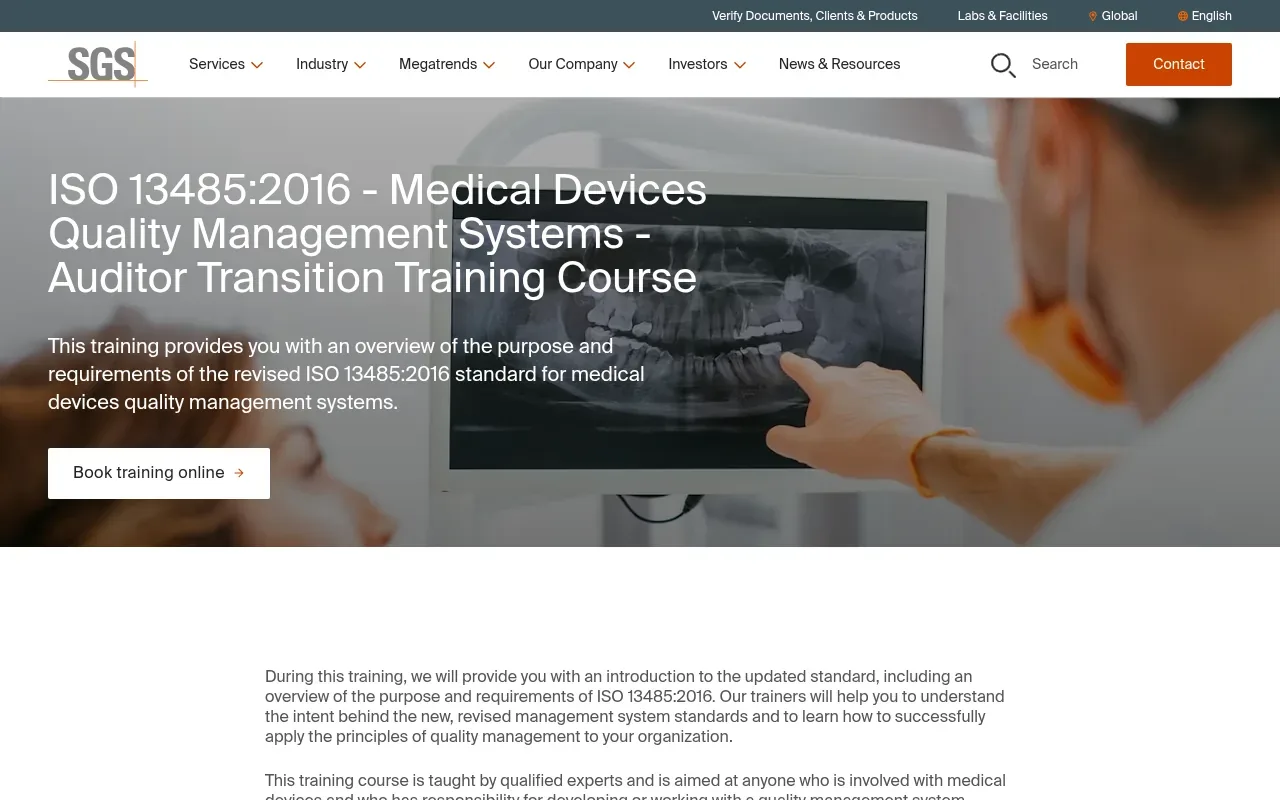
Prerequisites: the brochure expects prior knowledge of ISO 13485, management-system concepts and risk management. This makes it an internal audit training option, rather than a general introduction for someone encountering the standard for the first time.
SGS offerings vary by country and course listing. Before booking, check the local syllabus, language, time zone, delivery format, assessment method and certificate. The brochure's arrangements should not be assumed to apply to every regional course.
For software teams, ask whether exercises address design and development records, change control or traceability. If those examples are outside the course scope, plan a separate exercise using your own approved procedures.
Consider this option when: learners already have the required foundation and need internal audit training in a suitable local or virtual format.
What to check before enrolling your team
Compare the syllabus with an actual work assignment. A course description that mentions “quality systems” may cover very different tasks from a workshop on audit findings or software verification records.
- Starting knowledge. Ask what learners should already understand. If they cannot explain the purpose of the procedures they use, add foundational learning before an advanced audit course.
- Practice and feedback. Look for opportunities to plan an audit, review evidence or write a finding. Ask how the instructor assesses the work and helps learners correct mistakes.
- Software relevance. Ask about requirements, risk controls, traceability, verification and change management examples. General medical-device audit training may need follow-up work to connect it to your software lifecycle.
- Delivery arrangements. Check live session times, required prework, access periods and whether missed sessions can be made up. For a team booking, consider how attendance affects release and quality-system responsibilities.
- Certificate meaning. Establish whether the outcome is an attendance certificate, successful course completion or satisfaction of a training requirement within a separate professional certification scheme.
- Total cost. Request a current quote and check assessment fees, resits, learning materials, travel, taxes and cancellation terms where applicable. Include time away from normal duties in the comparison.
For US-market teams, also check FDA coverage. The FDA's Quality Management System Regulation (QMSR) took effect on February 2, 2026. It incorporates ISO 13485:2016 by reference alongside FDA-specific provisions. A course centered on the standard may not cover every FDA obligation relevant to your products.
Ask the provider to identify the FDA topics included in its syllabus. Then have your regulatory team assess whether additional training is needed for the organization's activities and markets.
Before requesting a quote, send the provider a short brief covering the learner's role, relevant experience, intended work assignment and any qualification requirement. Ask it to identify the matching syllabus sections and any gaps that need separate training.
Finally, agree how the manager will judge whether training helped. A useful measure is a reviewed work output completed to defined criteria. Attendance and an end-of-course score can inform that judgment, but neither should be the only evidence.
How to turn ISO 13485 training into useful work
Give each learner a defined opportunity to use the skill, with a reviewer and an agreed standard for acceptable work. Keep the first assignment narrow enough to receive useful feedback.
Hypothetical example: a MedTech team assigns a newly trained internal auditor to review how one completed software change followed its approved process. The audit is scoped and supervised, and the auditor is sufficiently independent of the work under review.
- Confirm the audit criteria and the boundaries of the sample.
- Trace the selected change through its request, review, applicable risk assessment and verification records.
- Ask process owners to explain how the work was performed and compare the explanation with the records.
- Document evidence clearly, distinguishing an unanswered question from a supported finding.
- Have an experienced reviewer check the reasoning and the link between any finding and its audit criterion.
This exercise tests whether the learner can apply audit methods; it does not establish that the entire product or QMS meets every requirement. The organization still needs to handle findings through its own processes and review the effectiveness of resulting actions.
If the gap concerns how to create or improve a procedure, use a separate development task. For example, ask the team to explain how a proposed change-control workflow connects responsibilities, risk review and verification. Have the process owner review the output before it becomes part of normal work.
That separation keeps the learning objective clear: an audit evaluates evidence against criteria, while process-development work changes how the team operates. Both may be useful, but they need different assignments and review arrangements.
Frequently asked questions about ISO 13485 training
Which ISO 13485 training should a beginner take?
Start with awareness or requirements training if the learner is new to medical-device quality systems. Match the course to their role and follow it with practice using relevant procedures. Check prerequisites before enrolling in an internal or lead auditor course.
What is the difference between internal auditor and lead auditor training?
Internal auditor training develops skills for auditing an organization's own QMS. Lead auditor training covers broader audit planning and leadership responsibilities, often including supplier and third-party audits. Choose by the work the learner will perform and the provider's stated entry requirements.
Does completing a course make someone an ISO 13485 certified auditor?
Course completion and professional auditor registration are separate outcomes. For example, CQI and IRCA's Lead Auditor grade requirements include qualifying audit experience as well as training. Completing a course also does not certify the learner's employer to ISO 13485.
How long does ISO 13485 training take, and can it be online?
The options above include 16-hour internal auditor programs and a 40-hour lead auditor program. Comply Guru combines eLearning with live workshops; the cited SGS brochure includes virtual instructor-led delivery. Confirm the current timetable and allow time for preparation, assessment and practice.
Does ISO 13485 training cover FDA QMSR requirements?
Check the syllabus. QMSR incorporates ISO 13485:2016, but FDA-specific provisions and other applicable FDA requirements still matter. For US-market work, ask the provider what it covers and have your regulatory team identify any remaining learning needs.
Can free resources replace a formal ISO 13485 course?
Free provider resources and official regulatory explanations can help learners orient themselves. Assess their scope, currency, exercises and feedback before relying on them for an assigned role. If you need a particular qualification, confirm its accepted training route rather than assuming a free resource meets it.
Choose your team's next step
Write down what the learner needs to do after training, what they already know and who will review their first attempt. Use those three points to select the course type, provider and follow-up assignment.
If the challenge is applying software-quality knowledge to current work, bring that challenge to IMSQ. We can discuss the scope, the team's learning needs and an appropriate next step. Book your IMSQ program review.